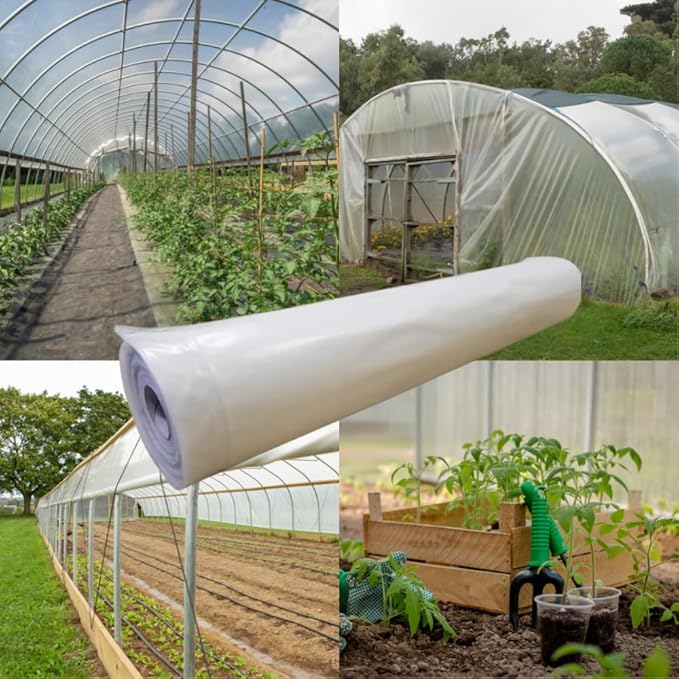

Flexible greenhouse films are usually made from low density polyethylene (LDPE), linear low density polyethylene (LLDPE), ethylene-vinyl acetate copolymers (EVA) and similar polymers. In their natural state these polymers deteriorate rapidly when exposed to sunlight. The sun's ultra violet (UV) light transfers its energy to the polyethylene molecules causing them to become so energized that they are readily subject to oxidation.
The degradation process is a series of reactions one leading to another of which the end products are carbon dioxide and water. The idea behind the stabilization packet which is put into the plastic mix at the time of production is to include components which will block, prevent as far as possible the onset of this process. As an example we are always including ultraviolet light blockers in order to try and prevent as far as possible the beginning of this reaction.
Several successful stabilizer additives have been used by film manufacturers to arrest this natural degradation. Big plastics manufacturers have begun to produce tough, clear, high PAR light transmission greenhouse films using hindered amine light stabilizers (HALS). HALS stabilizers protect greenhouse films by interfering with the propagation of free radicals. Free radicals are high energy, unstable, configurations which have a terminal, unpaired electron, formed when U V energy "breaks" a molecule (of the polymer, for example). A chain reaction can ensue with each radical potentially striking and breaking other molecules, releasing more and more radicals, until the film has degraded to the point of failure.
The HALS additive effectively restricts the multiplication of these free radicals. So a plastic film without proper UV stabilization (protection) will most certainly break down rapidly and leave the crop exposed.
Hence all the greenhouse film manufacturers do stabilize their film against degradation due to solar radiation. A cover of 200 microns thickness can be guaranteed for three years of service in the field against degradation due to UV.